What Are My Dallas Cowboys Cards Worth? How to Identify and Price Them
Found a box of Dallas Cowboys football cards? Here's how to identify exactly what you have — year, set, card number, base vs parallel — and look up what those cards actually sell for using eBay sold listings.


Someone finds a shoebox in a closet — a few hundred Dallas Cowboys cards, mostly from the era when Aikman, Emmitt, and Irvin were winning Super Bowls — and the first question is always the same. Are these worth anything?
The honest answer is that the box itself almost never is, but a handful of cards inside it might be. This guide shows you how to tell which is which: how to identify exactly what you have, and how to look up what that card actually sells for. We don’t quote prices here on purpose — card prices move constantly, and the only number that means anything is what a real buyer paid for the same card, in the same condition, recently.
Step 1: Identify exactly what you’re holding
You cannot look up a price until you can describe the card precisely. Four pieces of information do it:
The year. Flip the card over and find the copyright line — usually something like ”© 1991 Topps” along the bottom edge. That’s the year the card was printed. One quirk worth knowing: a card printed in a given year shows the previous season’s statistics, so the copyright year and the season you remember can be a year apart. If there’s no copyright line at all, identify the set by its design instead.
The brand and set. The front logo gets you most of the way — Topps, Score, Pro Set, Fleer, Upper Deck in the older stacks; Panini brands like Prizm, Donruss, Select, Optic, Mosaic, and Contenders in anything modern. Our era-by-era Cowboys sets guide maps which brands were producing NFL cards in which years, which is the fastest way to place an unfamiliar card.
The card number. It’s on the back, usually a corner. This is the card’s slot in that set’s checklist and nothing more — it does not indicate rarity. What you are looking for is a serial number: a fraction like 25/99 or 1/1, stamped on the card, telling you how many copies exist. A card number is an address. A serial number is a print run.
What type of card it is. Base cards make up the bulk of any set. Inserts are separate themed subsets. Parallels are the same card printed in a different colour or finish, usually scarcer than base. Autographs and relics (with a signature or a swatch of material) are scarcer still. On modern cards, rookies are usually flagged on the card itself — Donruss stamps its “Rated Rookie” designation, and most brands mark rookie-season cards clearly. For older cards there’s no logo: you have to know the player’s first season. Our player hubs list rookie years for every marquee Cowboy.
Step 2: Be honest about condition
Condition is the single biggest swing factor on common cards, and almost everyone overrates their own. Four things decide it:
- Centering — are the borders even on all four sides? This is where junk-wax-era cards fail most often. Measure it with our card centering tool rather than eyeballing it.
- Corners — look for the faintest whitening under good light. Sharp corners are rarer than you think in a box that’s been handled.
- Edges — chipping, especially on dark-bordered sets.
- Surface — print lines, scratches, gloss loss, and any indent from a rubber band or a binder page.
A card that looks “mint” across a kitchen table often isn’t once you check all four. That matters because on abundant cards, grade is essentially the whole story.
Step 3: Look up sold prices, not asking prices
This is the step that actually answers the question. Search eBay for your card — year, brand, player, and card number — and then filter to Sold Items. Active listings show what sellers are hoping for, which is frequently detached from reality. Sold listings show what somebody paid.
Three rules when you read the results:
- Match the card exactly. A base card and a parallel of the same player from the same set are different cards. So are the same card in two different grades.
- Graded and raw are separate markets. Don’t price your ungraded card off a PSA 10 sale, and don’t assume yours would grade there.
- Ignore the extremes. One unusually high sale is not the market. Look at the cluster of recent, comparable sales.
The buttons at the bottom of this page open live Cowboys searches you can flip straight into Sold Items.
Step 4: Know what the junk-wax era means for your box
If most of your cards fall between roughly 1989 and 1993, you’re holding the football hobby’s overproduction peak. Score and Pro Set both launched in 1989, breaking Topps’ long-running monopoly, and within a few years multiple manufacturers were printing simultaneously at enormous volume. Those cards were saved, not thrown away — which is exactly why they stayed common.
The practical consequence: for cards from this window, grade drives value, not scarcity. A stack of well-loved Emmitt Smith base cards is a stack of common cards. A genuinely pristine one is a different proposition entirely. That’s the framing on all three dynasty hubs — Troy Aikman, Emmitt Smith, and Michael Irvin — and it’s the single most useful thing to understand before you start sorting.
Step 5: What’s actually worth pulling out of the stack
Rather than pricing every card, pull these and check them properly:
- Anything pre-1980. True vintage predates the overproduction era and simply doesn’t survive in the same numbers. Roger Staubach’s 1972 Topps rookie and Tony Dorsett’s 1978 Topps rookie are the marquee examples. One trap to know: Topps did not hold the NFL license from 1964 to 1967 — Philadelphia Gum did — so some mid-60s Cowboys first-year cards aren’t Topps at all, and collectors searching only for “Topps” miss them entirely. Our Cowboys Hall of Famers card reference lays out that timeline against all 21 Canton enshrinees.
- Rookie cards of Hall of Famers. A player’s rookie-year cards stay the most liquid part of their market, in any era.
- Serial-numbered parallels, autographs, and relics. Anything with a fraction on it, an on-card signature, or an embedded swatch. These are almost entirely a modern-Panini phenomenon.
- Anything already graded. A slab from PSA, SGC, or BGS is a known quantity and prices cleanly against sold comps.
- Complete, unbroken team sets and sealed product. Sealed and complete has its own small market, separate from singles.
Everything else — the base commons that make up 90% of most boxes — is best thought of as bulk. That’s not a criticism; it’s what makes lots the right way to move them.
Step 6: Decide whether grading is worth it
Grading authenticates a card and locks in a condition score, and for the right card it changes the market it sells into. It also costs real money per card, both directions of shipping included. The arithmetic only works when a card’s graded value comfortably clears that cost — which rules out essentially every common card in a junk-wax box.
Grade the genuine vintage, the Hall of Fame rookies, the low-numbered parallels, and the autographs — and only the copies that are actually clean. Our free grading ROI calculator runs the break-even for you before you commit.
Step 7: Protect what turns out to matter
Once you’ve identified the few cards worth keeping separate, get them out of the shoebox. Penny sleeves inside toploaders for singles, semi-rigid holders for anything heading to a grader, and a proper binder or storage box for the rest. Rubber bands and loose stacking cause exactly the surface and corner damage that costs a grade point.
Where to go next
- Building rather than liquidating? Start with collecting Dallas Cowboys cards.
- Want to know which Cowboys cards collectors chase? See the best Dallas Cowboys cards to collect and the Cowboys legends list.
- Tracking a collection over time? Use the collection value tracker.
- Modern cards in the box? The Panini Prizm and Panini Donruss set guides explain the parallel structures you’ll run into.
Check real prices on eBay
Card prices are set by what people actually pay, and for Cowboys singles that happens on eBay. These open live listings — switch on the Sold Items filter to see completed prices.
Live Cowboys auctions ending soon
LIVEReal-time eBay auctions · bids shown are current · tap a card to bid on eBay
Browse every live “dallas cowboys card lot” listing on eBay →
Recommended Products for This Guide
Emmitt Smith 1995 23KT Gold Card Sculpted NFL Dallas Cowboys Graded GEM Mint 10
129 owner reviews
Emmitt Smith 1995 23KT Gold Card Sculpted NFL Dallas Cowboys Graded GEM Mint 10. Professionally graded and authenticated for guaranteed condition.
- Professionally graded
- Authenticated condition
Emmitt Smith 1995 23KT Gold Card Sculpted NFL Dallas Cowboys - Graded GEM Mint 10
10 owner reviews
Emmitt Smith 1995 23KT Gold Card Sculpted NFL Dallas Cowboys - Graded GEM Mint 10. Professionally graded and authenticated for guaranteed condition.
- Professionally graded
- Authenticated condition
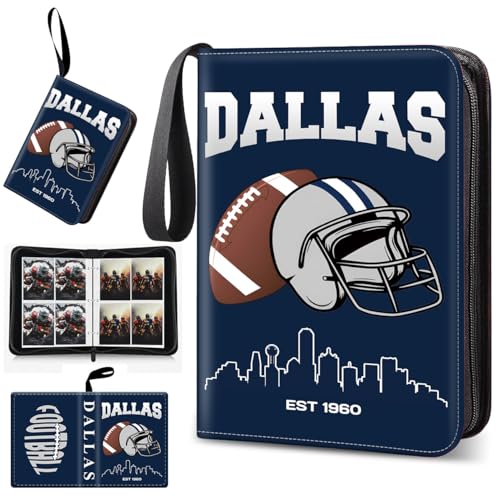
Football Card Binder, Dallas Trading Card Holder Protectors, 4 Pocket Fits 400 Cards with 50 Removable Sleevesves Card Storage Album Folder Case Collector
76 owner reviews
Football Card Binder, Dallas Trading Card Holder Protectors, 4 Pocket Fits 400 Cards with 50 Removable Sleevesves Card Storage Album Folder Case Collector. Essential supplies to protect and display your card collection.
- Protects your collection
- High quality materials